

| Frequently Asked
Questions? |
 |
|
Questions about pavers.
|
| |
|
Questions about
retaining wall systems. |
| |
|
Pavers
|
| |
|
Why do pavers make a better
pavement than asphalt or concrete? |
|
Properly installed
pavers stones provide a superior pavement to asphalt and
concrete in a freeze/thaw environment. Paving stones
provide a rigid yet flexible pavement that will expand
and contract with the freeze/thaw cycles. Each paving
stone provides and expansion joint to allow this
movement, unlike concrete slabs that have expansion
joints formed and cut into them. Paving stones can also
be easily dismantled to make repairs to utilities that
may be underneath the surface, and then repaired without
a path quilt look to the pavement. |
| |
|
|
How long do concrete pavers last?
|
|
Concrete pavers last over
30 years. This is much longer than other pavements under normal
residential use.
|
| |
|
How do pavers compare with patterned or
stamped concrete? |
|
Patterned concrete
pavements are merely slabs of concrete that are embossed with a
pattern. Therefore, they are prone to the same problems with
freeze/thaw cycles, namely cracking and palling. |
| |
|
Are all paving stones interlocking?
|
|
Some paving stones
interlock based on their shape. Others achieve interlock by the
laying pattern. When installed on a proper base with one inch of
sand as a setting bed, and proper joint sand placed between the
paving stones, all paving stones achieve interlock. |
| |
|
I have an existing concrete walkway
that is in pretty good shape. Can I lay down pavers over it?
|
|
While not the preferred
method, pavers can be laid on top of existing concrete walkways.
Two issues must be addressed. First, the grade will be raised by
about 3" (the thickness of the pavers plus the bedding sand).
This is particularly critical if any doorways are involved.
Second, if the existing concrete slab should raise or drop with
freeze/thaw conditions, then the pavers will do the same. |
| |
|
Can I use pavers on my pool deck?
|
|
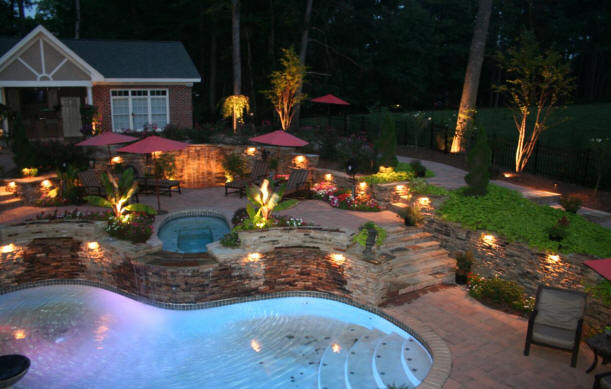
Not only do pavers make an
attractive pool deck, but they also provide a slip-resistant
walking surface. Pavers actually are better than poured concrete
around pools from the standpoint that the joints will take on
moisture and leave the pavement cooler under foot. Like all
products that are used outdoors, lighter colors will tend to
stay cooler as they reflect the sunlight. Furthermore, bullnose
pavers make a nice pool coping. Safety covers can also be
installed over pavers with the use of special anchors.
|
| |
|
Does the color fade over time?
|
|
No, color in concrete
paving stones does not fade. Dirt, dust and other inert matter
can mask the color in the paving stones. |
| |
|
How do I remove snow from my paving
stone driveway or walkway? |
|
Paving stones can be
shoveled and plowed the same as a concrete or asphalt pavement.
The chamfered edges around the paving stone help to prevent the
edges of the plow from hitting the corners of the stones. A plow
with a rubber edge is preferred.
|
| |
|
Can dirty or broken pavers be replaced?
|
|
Yes, you can be assured of
replacement pavers by keeping extras from the job. When
replacing a paver, scrape out the sand in the joints from those
surrounding the paver to be removed. Use two screwdrivers to
wiggle it out. Others can be removed by hand. Insert the new
paver, replace the joint sand, compacting the paver into place
with a rubber mallet. |
| |
|
Will freezing and thawing damage
pavers?
|
|
No, damage from ice is
virtually non-existent. The joints allow the pavers to move
without cracking in freeze and thaw cycles. |
| |
|
If pavers need to be removed for below
grade repairs, can I replace them afterwards? |
|
Yes, unlike other
pavements, concrete pavers can be easily removed and reinstated
without any visual or functional changes. |
| |
|
Will the aggregate area absorb or hold
water? |
|
No, when compacted
properly, its density will minimize deformation and/or heaving
of the paved surface during freezing or thawing. |
| |
|
Will the bedding sand be loosely
screened to a depth of 1", but no thicker than 1 thick?
|
|
Yes, the loosely placed,
even layer of washed, course sand provides on the sand and
compacted, the sand moves up into the joints. This causes the
pavers to interlock and become level after compaction. |
| |
|
Are the joints filled between the
pavers?
|
|
Yes, with clean fine sand.
The sand should be dry sand so it will flow freely into the
joints. The pavers are compacted during and after filling to
begin interlock of the units and prevent sand from washing from
the joints. |
| |
|
Do I need to seal the pavers?
|
|
No, pavers are extremely
durable. Sealing, however, may enhance the colors and may
prevent staining. Sealing will also help to bind the sand in
place and prevent germination of weed seeds that may collect at
the surface of joint sand. One disadvantage to sealing paving
stones is that it would need to be sealed every couple of years.
Consult David or Dale for recommendations on cleaning and
sealing. |
| |
|
Will weeds grow up from my paving
stones?
|
|
The growth of weeds or
grass can result from seeds blowing and lodging in the joint
sand. Weeds do not grow up from the bottom through the quarry
process. Controlling these weeds is a simple solution. Mix a
pre-emergent weed killer into the joint sand. Should weeds
germinate over time, the use of a post emergence weed killer,
such as Round-up, can be spot sprayed to control the problem. |
|
Retaining Wall Systems
|
| |
|
How high can walls be
built without the use of geogrid? |
|
Walls can be constructed
between 2' and 6' high depending on the type of unit, soil
conditions, amount of batter used, and surcharged on top of
wall. |
| |
|
What is geogrid? |
|
Geogrid stabilizes the
soil mass behind the retaining wall and ties the wall face to
the earth being retained. Typically made of polypropylene,
geogrids are open-celled, directional fabrics that are placed
between the layers of block at different intervals. |
| |
|
Are concrete footings ever necessary or
required? |
|
Most walls can be built
directly on 4-6" of well compacted granular base. Generally,
the higher the wall, the thicker the base. You do not have to
dig down below the frost line. However, there may be occasion to
consider the use of a concrete leveling pad. |
| |
|
What do I use to backfill my wall?
|
|
The first 6" -12" behind
the wall should be backfilled with a " - " clean stone to help
relieved any hydrostatic pressure that might build up. The area
directly behind the stone should be compacted soil. |
| |
|
I need steps in my retaining wall. What
can I do? |
|
All retaining wall
products can be used to build steps. The wall units are used for
the riser and the caps for the treads (bullnose pavers can also
be used for treads).
|
| |
|
Should I use a corrugated plastic pipe
(drain tile) behind my wall to drain water away?
|
|
Due to their mortar-less
construction, segmental retaining walls will naturally Weep to
relieve any hydrostatic pressure that builds up behind the wall.
As a rule of thumb however, its a good idea to use a drain
tile directly behind the wall units at grade level for all wall
applications. |
| |
|
Can I make a curved wall with wall
systems?
|
|
One of the many advantages
over a railroad tie wall is that walls, with either inside or
outside curves, can be built with all wall systems. Blocks with
tapered sides are use for outside curves, and inside curves can
be created by placing the front corners together and gapping the
units in the back.
|
| |
|
What do I use to adhere the caps on my
retaining wall? |
|
Use a high strength,
flexible concrete adhesive, or mason mortar, to affix your wall
cap. |
| |
|
Can I build a freestanding wall using
any retaining wall systems? |
|
Absolutely! Use double
sided wall to increase your creative options for walls that are
functional and look great.
|
| |
|
What are terraced walls and how do I
plan for them? |
|
Terraced walls are two or
more walls placed in a multi-level arrangement. The second wall
should be located behind the first wall at a distance of at
least twice the height of the first wall under ideal soil
conditions. Walls constructed in this method should not exceed
four (5) feet high each.
|
|
|
| back to top |